






Dear Friends and Neighbors,
With the 2027 legislative session just a few months away, much of my time has been spent preparing for the work ahead. I’ve been meeting with community leaders, fellow legislators and stakeholders, attending meetings and listening to the issues that matter most to the people and communities I represent. These conversations are an important part of preparing for session, and I appreciate the opportunity to hear different perspectives before we return to Olympia.
In my last update, I shared some of my concerns about Washington’s growing state budget and the difficult decisions facing the Legislature. Since then, we’ve received an updated revenue forecast that gives us a clearer picture of what to expect in the coming years.
At the same time, two former Democratic governors, Gary Locke and Christine Gregoire, have been raising concerns of their own about state spending, fiscal discipline and Washington’s declining competitiveness. Their comments caught my attention because these are challenges that should concern all of us, regardless of political party.
In this update, I want to take a closer look at the revenue numbers, share some of what these former governors have been saying and explain why I believe these conversations are especially important as we prepare for the 2027 session.
More revenue doesn't eliminate the need for spending discipline
The September revenue forecast gives us a clearer picture of how much money the state expects to collect over the next several years. According to the Washington State Economic and Revenue Forecast Council, projected revenue for the current 2025-27 budget cycle is approximately $76.3 billion. That figure is expected to increase to $82.6 billion in 2027-29 and $94.1 billion in 2029-31.
The Washington State Office of Financial Management also provides a helpful summary of the September forecast and what the updated projections mean for the state’s budget outlook.
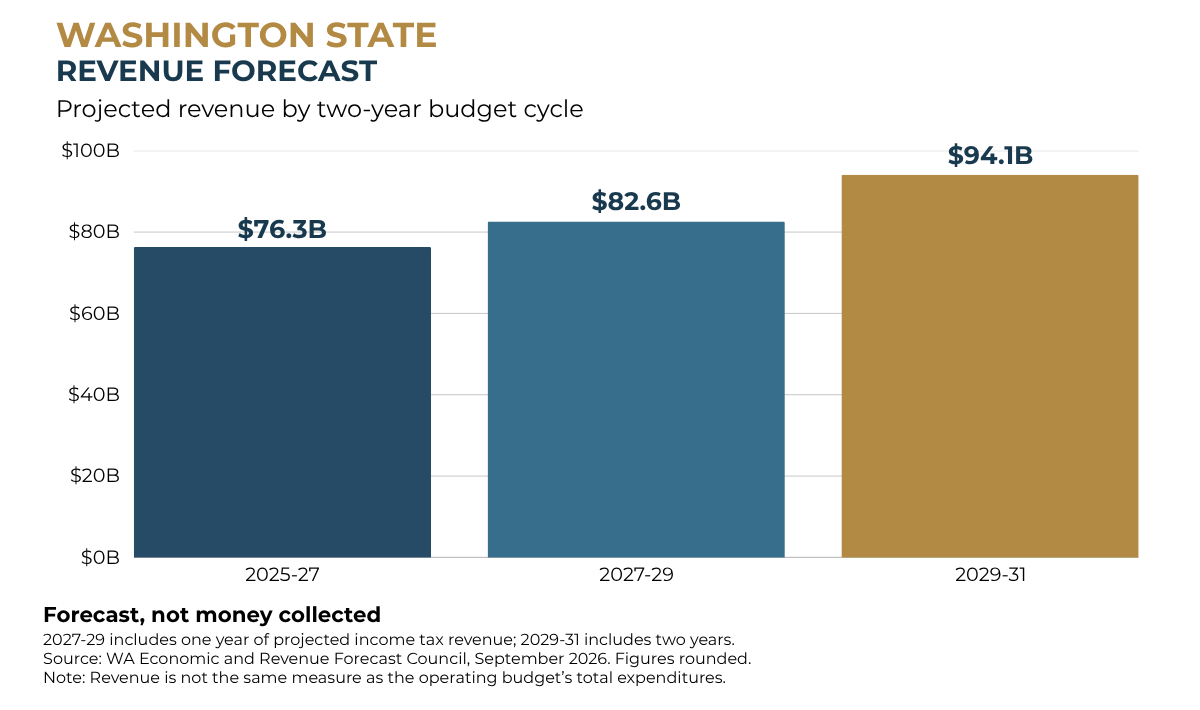
Note: These are revenue projections, not actual collections or total operating budget expenditures. The future forecasts include anticipated revenue from the new income tax.
At first glance, those numbers might look encouraging. State revenue is projected to continue growing, so you might wonder why we’re still talking about budget challenges. The answer has a lot to do with how quickly state government is spending the money it receives.
Before getting into that, it’s important to remember that these figures are forecasts, not guarantees. Economic conditions can change, and some of the projected revenue growth comes from recently enacted taxes. The 2027-29 forecast includes one year of anticipated income tax collections, while the 2029-31 forecast includes two years.
But even with that additional revenue, we can’t ignore what’s happening on the spending side. In my last update, I shared a chart illustrating the growth of Washington’s operating budget.
A decade ago, the state’s two-year operating budget was approximately $38.2 billion. Today, it’s about $80.2 billion. We’ve more than doubled spending in just 10 years, and I believe that pace should concern all of us.
My concern isn’t that we’re spending money on important services. We have real responsibilities to our schools, public safety, transportation and those who depend on essential state programs. But we’ve allowed spending to grow too much, too quickly, without taking a hard enough look at our priorities or whether taxpayers are getting the results they deserve. When government continues to expand its commitments without making difficult decisions about what matters most, even growing revenue struggles to keep pace. And the answer can’t always be another tax or a new source of revenue.
We need to be asking some basic questions. Are we making the best use of the money we already collect? Are existing programs delivering the results we promised? And are we making spending commitments that Washington taxpayers can realistically sustain?
Those are the conversations I believe we should be having as we prepare for the 2027 legislative session. Before we ask Washingtonians to pay more, we need to demonstrate that we’re spending their money wisely and putting our priorities first.
A conversation worth having about Washington's future
The concerns I’ve raised about spending and priorities aren’t unique to me or my Republican colleagues. In fact, two former Democratic governors, Gary Locke and Christine Gregoire, have recently expressed similar concerns about Washington’s fiscal direction and business climate.
Locke was particularly direct in his assessment of state spending, saying, “There’s no budget discipline. They’re taking one-time money and creating permanent programs without any thought as to how they are going to sustain that program when that one-time money goes away.”
Coming from someone who has served as governor and understands the difficult decisions involved in managing a state budget, that’s a statement worth paying attention to.
Former Gov. Christine Gregoire joins Elephant in the Dome
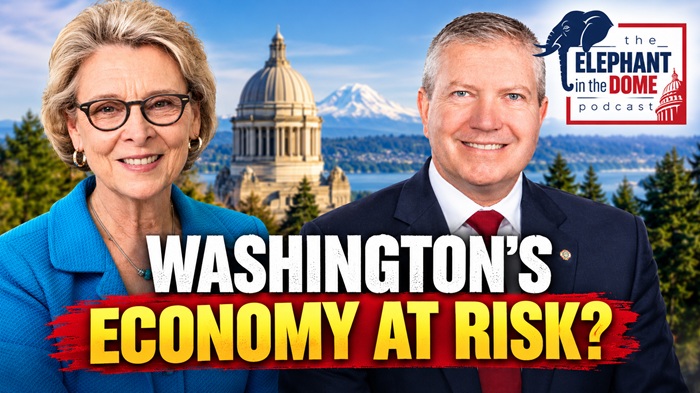
Former Gov. Christine Gregoire raised similar concerns during a recent episode of Elephant in the Dome, the Senate Republican Caucus podcast. In her conversation with Sen. Chris Gildon, she discussed Washington’s changing business climate, the importance of fiscal responsibility and the challenges facing our state’s economy.
One of her comments particularly stood out to me: “Business isn’t the bad guy. Business is jobs. It’s our future.” I think that’s an important reminder. When we talk about taxes, regulations and government spending, it’s easy to lose sight of the people and businesses that drive our economy and support our communities.
Here in the 10th District, we see that connection every day. Small businesses, manufacturers, agricultural operations, tourism and other local industries provide jobs, support families and contribute to the economic health of our communities.
But as the cost of doing business continues to rise, employers face increasingly difficult decisions about hiring, investing and expanding. Those decisions have consequences beyond the businesses themselves. They affect the jobs available to our neighbors; the prices families pay and the opportunities our communities can offer.
Gregoire also offered a broader assessment of where Washington stands today: “We have become much less competitive than what we want to be and what we were. And so we’ve got our work cut out for us.”
I agree that we have work to do, and I appreciate hearing these concerns from leaders on both sides of the political aisle. Because at the end of the day, this isn’t about Republicans or Democrats. It’s about people. It’s about families trying to make ends meet, businesses working to keep their doors open and workers looking for opportunities to build a better future. We may not agree on every solution, but we should all want a Washington where people can afford to live, businesses can thrive and state government makes responsible decisions with the money entrusted to it.
If you have a few minutes, I encourage you to listen to the Elephant in the Dome conversation. It’s an interesting discussion about the challenges facing our state and the importance of thinking beyond the next budget cycle.
Making responsible commitments for the future
Gregoire raised another point during the podcast that goes right to the heart of Washington’s budget challenges: the difference between temporary funding and ongoing spending commitments.
During the pandemic, Washington received significant amounts of one-time federal funding to help address immediate needs. But that money was never intended to be a permanent source of revenue, something Gregoire emphasized when she said, “We can’t take money like Covid money, which is one time money and put it into ongoing programs.”
It’s a straightforward principle. Whether you’re managing a household, running a business or overseeing a state budget, you can’t rely on temporary money to pay for expenses that continue year after year.
Yet that’s part of the challenge Washington faces today. State spending has grown rapidly, and we’ve taken on commitments that are becoming increasingly difficult to sustain. Rather than taking a hard look at what we’re spending and where our priorities should be, the conversation too often turns to finding additional revenue.
I believe we need to change that approach as we prepare for the 2027 legislative session. Before considering new taxes or expanding programs, we should be evaluating what we’re already funding, whether those programs are delivering the results Washingtonians expect and whether we can afford to sustain them over time.
And we can’t overlook the broader consequences of those decisions. Ultimately, responsible budgeting isn’t just about balancing numbers on a page. It’s about setting priorities, making thoughtful decisions and protecting the opportunities and quality of life that Washingtonians depend on.
Worth reading and listening to
If you’re interested in learning more about these discussions, I encourage you to explore the following coverage and conversations:
- Ex-governor says WA budget is almost double 2013’s. What does the math show? (The Olympian)
- Former governor, US Ambassador Locke says WA needs to curb spending, stop ‘distrust’ (KOMO News)
These perspectives reinforce something I’ve said before: We don’t have to agree on every issue to recognize that Washington needs a more sustainable approach to budgeting.
Next up: Transportation and our ferry system
In my next update, I want to turn our attention to transportation, particularly the challenges facing Washington State Ferries. For those of us who live in the 10th District, reliable ferry service is essential. It connects our communities to jobs, health care, schools and the people and places that matter to us.
There’s a lot to discuss, including service reliability, vessel availability and the long-term investments needed to keep the system operating. I’ll share more about those issues and what I’ll be watching as we head into the legislative session.
As always, my office is available to help throughout the year. Whether you have a question about state government, need assistance navigating a state agency or simply want to share your perspective, please don’t hesitate to reach out.
Thank you for staying engaged and for giving me the opportunity to represent our communities in Olympia.
It’s an honor to serve you,
 Sen. Ron Muzzall, 10th Legislative District